ATP players returning serves from more than five meters behind the baseline won only 41 percent of second serve return points at the 2023 Indian Wells tournament. That specific metric contradicts a decade of tactical evolution on the professional tour. Daniil Medvedev built a championship career utilizing this exact defensive positioning.
Why Reaction Time Is Actually An Illusion
Tennis coaches spent the last five years teaching players to retreat against massive servers. The prevailing logic suggests that adding distance increases the time available to read the ball path. This assumption works flawlessly on fast indoor courts and slick grass.
That belief breaks down entirely on gritty outdoor acrylic surfaces. Giving a heavy topspin ball extra distance simply allows the spin to multiply its effect off the bounce. The receiver trades a fraction of a second in reaction time for terrible geometric angles.
How High Friction Courts Alter Tennis Physics
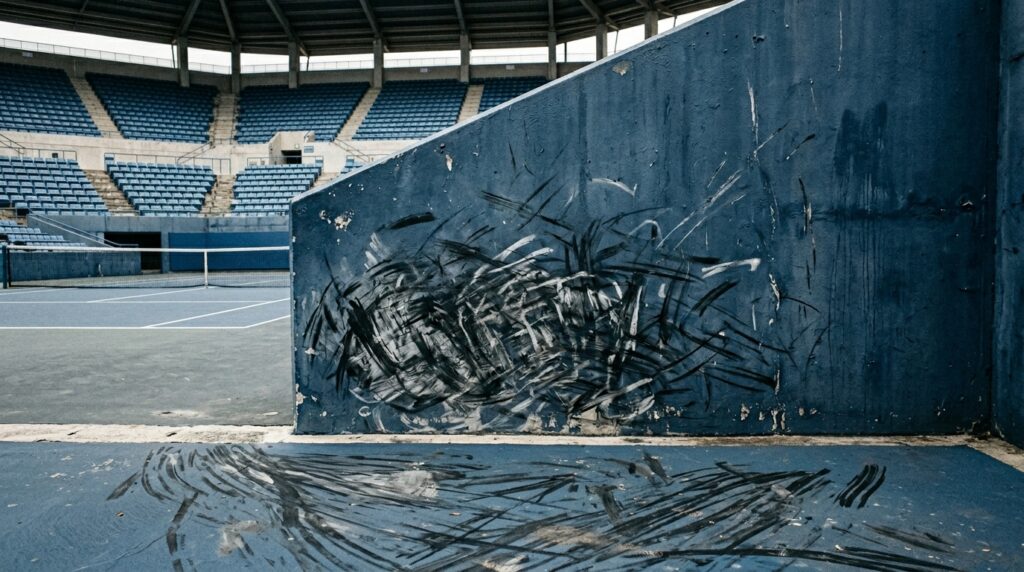
Heavy courts physically alter how the ball travels through the air after bouncing. The court pace index in the California desert regularly hovers around 27. This categorizes the surface as slow and highly receptive to heavy spin.
The actual mechanism unfolds in three distinct stages during a service game.
- Step 1: The server applies heavy rotation to drag the ball out of the center of the court.
- Step 2: The abrasive paint grips the ball and forces it to kick sharply sideways instead of sliding forward.
- Step 3: The receiver standing near the back wall must cover significantly more lateral distance just to make contact.
Outcome Bias Blinds Us To Bad Strategy
Fans constantly fall victim to Outcome Bias when evaluating tennis strategies. Viewers watch a baseline grinder win a major tournament while standing near the line judges. They immediately assume that specific tactic represents the optimal way to play the sport permanently.
Outcome Bias forces observers to ignore the environmental context of that victory. A fast surface like the US Open rewards pure defensive absorption and deep positioning. We lazily project that successful outcome onto completely different physical environments.
This mental error prevents audiences from recognizing a terrible tactical decision until the match is already lost. We assume the elite player knows best because they succeeded previously. Observers ignore the physics happening right in front of them.
Baseline Aggression Will Return Soon
Players will soon realize that retreating represents a mathematical dead end on abrasive courts. The next generation of champions must revive the lost art of taking the return early. Stepping inside the baseline cuts off the angles before the heavy spin can activate.
Geometry will always defeat pure athleticism over a long enough timeline.
Are you paying attention to the court surface, or just watching the scoreboard? This is the kind of analysis GlobanSport publishes every week. No paywall. No filler. Just the sport behind the sport. Follow us and read it first.